The magical ways to connect with your teams and inspire them to do the best they could


Running a company has never been easy — that is what I can say to my peers, based on experience working with a dozen companies, multiple teams, and remarkable people, mostly through sharing countless ups and downs over the last 15 years. One of the hardest challenges, alongside working on complex technology and managing company cash flow, is ensuring your people are deeply engaged with the vision the company has set. It is challenging because it deals with people who 1. are human, and 2. operate without the consistent, universal answers you find in mathematics or in coding tasks with clear inputs and outputs. I do not mean to de-emphasize the work of other functions — everyone in a company faces their own set of challenges: the CEO sets the vision and pursues investors; the VP keeps the organization well-oiled and focused; an engineer ships a customer feature; a customer support agent keeps customers happy. But it is especially important to understand what motivates people — which is not entirely about money or benefits — and then find a way to have your people resonate with that deeper purpose.
You may be here not only because of the title but also because, as a manager, you see team effort scattered, energy low even when there is good news, and other warning signs you are hoping to find a formula to address. The truth is, there is no single formula to give. I have had to judge every situation based on a number of factors: the company vision, the team composition, ways of collaborating, culture, existing people, managers, and workload. The right approach also varies case by case and over time, so managers need to expect to be adaptive. In this post, we will look at an interesting case study I experienced firsthand, along with some insights that may be useful to you.
Skunkworks, back in 2010, was the hottest startup in Vietnam, attracting top talent from multiple countries to do, well, skunkworks-style work. The product could be described as event planning with friends — something like Facebook Events today. Four years in the making, yet the team could not ship a strong minimum viable product to gain traction with customers. Still, dozens of millions of dollars were spent iterating on ideas, processing location data, marketing, salaries, and Google-level perks. Team members at different levels were arguing over simple feature requests, which easily stretched into 2-week cycles instead of 2 days. People got lost in protecting their opinions rather than aligning around shared goals. In the end, there were a collection of superstars with little to no collaboration and too much distrust. It was the perfect recipe for disaster. Then one day, the team was utterly shocked to learn that Skunkworks would shut down within days — almost nobody had anticipated it could happen. With better product management this could likely have been avoided, but one equally important cause I observed was the way the team — including me, as a mobile developer — had lost its connection to the vision and to each other.
To this day, I believe the ship could have been saved if that connection, as one of the critical countermeasures, had been stronger. How much could a developer who had joined only two months earlier — armed with observations and ideas — realistically steer a whole organization rushing at full speed? Not very much. I had no direct manager; my access was limited to the VP of Engineering and the CEO, and my attempts to get their attention did not go far. The best I could do was deliver my work well and build genuine relationships with peers. Even when someone has the influence to make change, it is incredibly difficult to act once certain behaviors have become deeply entrenched — let alone win hearts from superstars with large egos. The shutdown of Skunkworks was ultimately the right financial decision. I was fortunate to be selected for Skunkworks 2.0 a few weeks later. The new team was scaled down from 100 people to an elite team of 10, with a revamped yet clear vision. The second MVP was delivered confidently within weeks, team bonding was strong, and everyone understood their purpose.
It was a true cross-functional team that ate, worked, and played together — before Agile became trendy. Starting over is one of the most effective ways to rebuild team connection and alignment, sometimes more effective than trying to patch existing issues incrementally. Convincing individuals to correct entrenched behaviors takes a long time and a great deal of patience. Forcing change leads to frustration. Public announcements may or may not generate the response you hope for. Getting buy-in at multiple levels of leadership — top, middle, and bottom — can produce great results, but the alignment needs to run throughout the entire chain. It does not have to be as rigidly hierarchical as in the military; the main point is to establish a shared view toward a vision before driving change. Humans also tend to resonate more with those they work closely with than with the organization as a whole.
This is why team structure has a direct impact on helping people connect to their purpose, which in turn aligns to organizational vision and encourages them to do their best. Having two people work on a temporary project and calling it a team does not feel right; equally, telling a group of people to figure out their purpose without sharing a vision is a waste of effort. From various sources you can find articles about Spotify's engineering culture around aligned autonomy, with the repeating mantra: "Do X, figure out how."
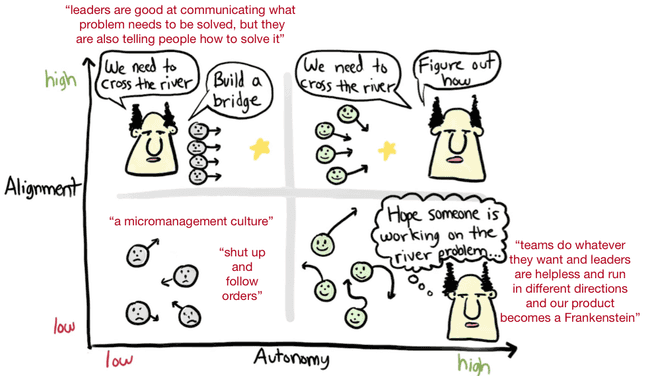
Credit Paul Hammant
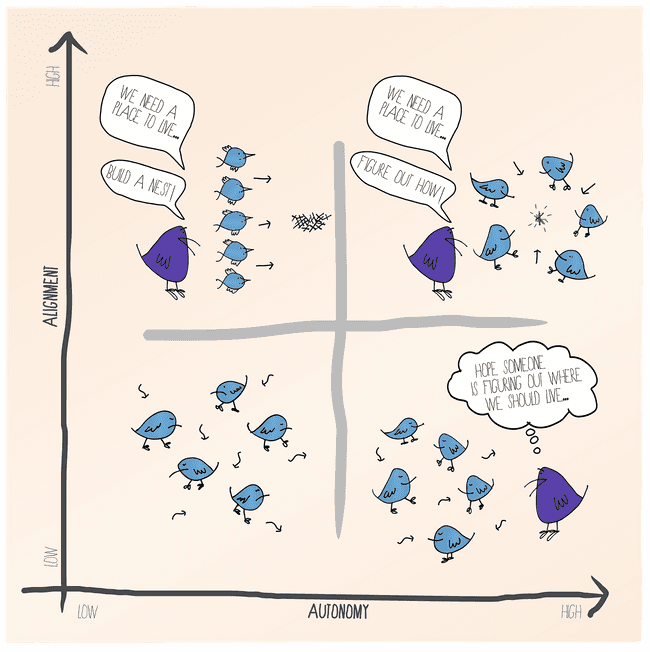
Or this one, with a touch of sarcastic humor. Credit Favro
At first glance it looks like a manager's dream. What those articles do not show is: first, Spotify itself does not use the Spotify model (link); second, the model only works given high trust between team members and the manager; and third, the manager needs to operate as part of the team, not as an external driving force. As a manager, you should explain your way of working and leadership style to the team and ensure everyone is comfortable before adopting any new model.
It is also worth noting what Amy Edmondson's research on psychological safety tells us: people contribute their best work in environments where they feel safe to speak up, take risks, and admit mistakes without fear of judgment. Building that kind of environment is not a nice-to-have — it is foundational to sustained team performance. Connection and inspiration rest on it.
Now to the final part: inspiring your team to do their best. I can only offer advice from my limited experience leading teams as a technical founder of a small startup.
••• The higher your role, the greater your impact — and the less clear the path to the right outcome, since fewer people tell you what to do. The best way to solve this? Enable your teammates to step into your domain and trust them to handle your challenges. That way, you help them grow while the whole team achieves its goals together.
••• Help your team grow, in whatever way you and your team agree is right. Few people remain happy doing the same work for years without some form of personal development or visible opportunity to advance. If you can help a developer step up to team lead, great. If you can help a team lead become a manager, even better.
••• It is always a balance to strike: how much control to exercise, how directly to expose the team to frontline pressure versus how much to shield them so they can focus on their daily work.
••• Build lasting human-to-human relationships. Leadership in your organization must genuinely value this work. If it does not, surface that as early as possible and put a strategy in place — ideally from the time the company is founded. The longer an organization runs without this foundation, the harder it becomes to build.
••• Connection is more powerful when it is bidirectional. People are perceptive enough to sense whether your approach to them is genuine, no matter how hard you try to conceal it. You can choose what to give, but you cannot control what comes back.