The Feedback Loop Is the Product: Rewiring Mobile App Development with AI


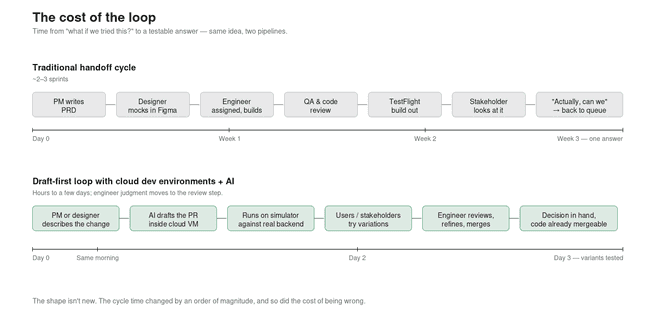
Ask any mobile org what slows it down and you will not hear "I can't write code fast enough." You will hear some version of this: a PM has a question; a PRD gets written; a designer mocks it; an engineer is assigned; two sprints later it lands in TestFlight; someone opens it and says, "actually, can we try it with the CTA at the top?" Back to the queue. This is a feedback loop problem, not a productivity one, and the cost of being wrong at the front of the cycle is paid in engineer-weeks at the back.
Most "AI in mobile development" pitches aim at the wrong end of this loop — making engineers write code faster, which is the least interesting version of the story. The more interesting version is that AI collapses the loop itself, by letting the people who actually have the question (PMs, designers, sometimes marketing) get a working answer in front of themselves before any engineer is paged. What follows is a working theory of how to set that up. Most of it leans on what I've seen across mobile teams building on Bitrise's Remote Dev Environments, with Stripe's account of its in-house coding agents as a useful waypoint for what scale eventually looks like.
AI before the code
Most of the noise around AI in mobile development is about generating code. The more interesting moves happen earlier — upstream of the PR, where ideas are still fuzzy and the cost of being wrong is at its highest. Three places are already worth pulling AI into, and most teams are leaving them on the table.
Functionality clarification. Most product ideas arrive vague. A PM knows the rough shape of the feature and not much else. AI is good at interrogating an idea before any pixels are drawn — what's the empty state, what happens on the second login, what about offline, what about a flaky network, what about the user with thirty saved cards. These are the questions that otherwise surface two weeks later, in engineering review, and trigger the rework. Doing them in a five-minute conversation with a model turns a fuzzy brief into a sharp one. The artifact isn't code; it's a clearer specification of the thing being built.
Design mockups and variations. Generating UI mockups from a description, or variations from a single mockup, is no longer expensive. The output isn't a finished design — it's a set of conversation starters. The senior designer's job shifts from drawing to curating, which is the more valuable work anyway. The compression here is in the time between "I have a hunch" and "I have something concrete to argue about," and it can collapse from days to minutes.
Spec to working draft. Once the brief is sharp and the design is anchored, the same loop produces a draft pull request — code that compiles, runs on a simulator, and demonstrates the idea well enough to test. This is the move that the rest of this essay is built around. The important reframe is that this is drafting, not shipping: the PR is a proposal in code, not a release. An engineer reviews, refactors, and either merges or rejects. What changes is that all three of these steps — clarifying, mocking up, drafting — can happen in the same morning, with the same person, instead of waiting two sprints to find out the wrong thing was built.
Whatever the underlying agent or assistant, two principles are doing the heavy lifting. The first is asynchronous by default: no human blocking on an agent, no agent blocking on a human. The pull request is the interface, and it inherits twenty years of code review tooling and norms. The second is environment parity with CI: if the place the code is drafted drifts from the place it's tested, the drafts produce code that compiles for the author and fails the second CI sees it — the worst possible failure mode, because it teaches reviewers to mistrust the source for reasons unrelated to the code itself. Stripe's public account of its own agents lands on the same two properties at industrial scale; the shape is borrowable even if the volume isn't.
Why mobile is hard mode
Mobile makes both of those properties expensive. Builds are slow (15–40 minutes for a non-trivial iOS app), the toolchain is macOS-locked and Apple-Silicon-priced, code signing is a small bureaucracy, and the runtime surface is heterogeneous enough that "works on my simulator" is the new "works on my machine." These are real, and they shape every architectural decision downstream — but they are also well-trodden by infrastructure teams.
The part that is genuinely under-weighted is the backend. The backend matters. A mobile feature is rarely a UI change in isolation — it touches an endpoint, a feature flag, an analytics event, a notification payload. If the PM is drafting against a stale staging backend, half of what they discover is artefacts of stale data. If they're drafting against production, every variation they try is touching real users. The only correct answer is ephemeral, per-draft backend environments that share a lifecycle with the mobile session: spun up together, archived together, torn down together. This is the piece that separates the orgs where this actually works from the orgs where the PMs eventually give up. Every primitive — container-per-service, sanitized snapshots, scoped feature flags — has existed for years. The work is stitching them into one PM-facing experience tightly coupled to the mobile environment.
Four ways to actually build this
Once you accept the premise — PMs and designers should be able to produce working drafts that engineers refine — there are roughly four shapes. Only two survive contact with a serious mobile codebase, but the failures are instructive.
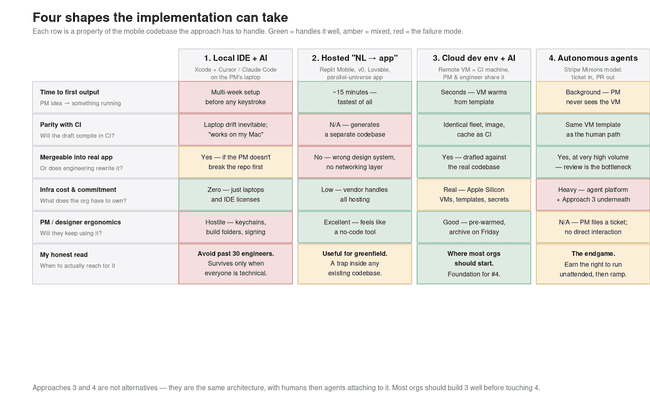
Approach 1 — Local IDE plus AI assistant. Zero infrastructure cost; uses tools engineers already understand. But "set up your Mac for iOS development" is a multi-week, demoralizing odyssey for a non-engineer. The first time the PM hits a "clean build folder, restart Xcode" loop, they quietly close the project. Works in a small startup where everyone is technical. Does not work at scale.
Approach 2 — Hosted "natural language to app" platforms. Replit Mobile, v0, Lovable. Extraordinarily low friction. But it solves the wrong problem: the PM is proposing a change to an existing app, not building a new one. The draft is a parallel-universe app that can't be merged into anything. Useful for greenfield prototyping; a trap inside any existing codebase.
Approach 3 — Cloud dev environments with AI assistants. PM, designer, and engineer all attach to a remote VM with the right Xcode, the right caches, the right secrets, the right backend. "Works in my dev env but not CI" evaporates — the dev env is the CI env. Sessions are persistent and archivable. The cost is real infrastructure: Apple Silicon hosts, template management, session lifecycle, credential scoping, persistent storage, and network paths from the VM to your backend.
Most teams should buy this layer, not build it. Each component is non-trivial on its own, and they have to interoperate cleanly — a template that drifts from CI, a session that fails to restore, a credential that leaks the wrong scope, and trust evaporates inside a week. That work is multi-quarter platform engineering for a dedicated team, and the differentiator was never the platform anyway. The differentiator is what your product team does with it. The vendors who have already solved the orchestration let you skip the construction phase and put the value in front of users immediately.
Approach 4 — Fully autonomous one-shot agents. A PM files a ticket; an agent spins up an environment, writes the code, runs the tests, opens a PR, shuts down. Highest leverage by an order of magnitude when it works. Reaching it on your own means building, on top of a working Approach 3, an interlocking set of non-trivial systems: a ticket-to-agent orchestrator that decides which work an agent is allowed to pick up; a mobile-aware agent harness that reasons about Xcode build phases, Swift's type system, iOS simulators, and the accessibility tree; test infrastructure dense enough that "tests pass" is meaningful signal, including real-device runs for the bugs simulators miss; reproducibility guarantees so success rates stay consistent over months; PR-summary tooling and reviewer routing for the volume of PRs that will land; and the operational backbone — cost controls, observability, safety guardrails — so a misbehaving agent doesn't burn the credit card or push something it shouldn't.
This is a multi-year platform investment for a dedicated team, and very few orgs outside the largest mobile shops are positioned to make it. That's why Approach 3 is the rational starting point. It uses the same primitives Approach 4 will eventually need — templates, sessions, environments, MCP, real-device runs — and it delivers value to non-technical teammates the day you turn it on. The maturity earned here is exactly what lets agents run unattended later, first for narrow, low-risk categories (dependency bumps, accessibility audits, copy changes, lint fixes) and then progressively more. You earn the right to Approach 4 by operating Approach 3 well for a year first.
Approach 3, made concrete
Abstractions are easy to nod along with. Here's the same workflow as a single, end-to-end prompt — the kind a PM, a designer, a marketer, a customer success lead, or any non-technical teammate with an idea could type into their AI assistant, with the remote dev environment MCP server connected:
Do the following steps:
1. Define a unique session name: "team-work-<username>-<timestamp>",
   where username is my Claude subscription username without the email
   domain, and timestamp is the current epoch value.
2. Open an RDE session under the "Team Work" template with that session
   name, and pass this prompt to Claude Code:
     "Open the iOS project under ~/git/Testing, update the main screen's
     background colour from white to grey, add a button in the centre
     which opens a popup saying Testing123 when clicked. Capture a
     screenshot of the simulator with the popup open. Commit the code
     changes with a relevant commit message to a branch with a meaningful
     name; do not commit the screenshot file. Then open a pull request in
     https://github.com/org/MainMobile — include the screenshot in the PR
     description."
3. Show me the screenshot of the simulator with the change.
4. Clean up: archive, then delete the RDE session.
5. Follow the pull request's checks and find the associated CI build.
6. Post the CI build URL here.
What matters here isn't the mechanics — it's what the person typing the prompt does, and does not, have to do. They don't install Xcode. They don't manage credentials, simulators, branches, or CI configuration. They never see a session, a template, an MCP call, or an archive. They write a sentence in English. Minutes later, the screenshot lands in their chat and a CI build is verifying the change against the real codebase.
Cycle time from "I have an idea for the main screen" to "there's a reviewable PR with a verified screenshot and a green CI build" is measured in minutes. The person who triggered it — PM, designer, marketer, anyone — never installed a developer tool. The engineer's reviewer experience is unchanged. The orchestration — sessions, templates, archives, lifecycle, MCP — happens behind the prompt.
A reference architecture, end-to-end
The dominant paradigm in three years is a hybrid of Approach 3 and Approach 4 — humans and agents in the same cloud environment, PR-as-interface as the default. The implication is unambiguous: the AI story in mobile is downstream of the build infrastructure story. Get the environment right first; everything else compounds from there.
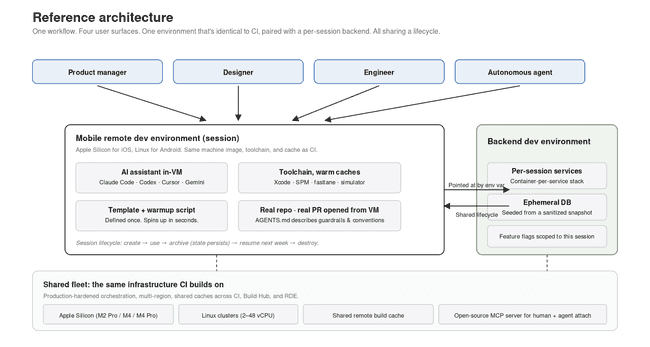
The architecture itself the diagram makes plain. The non-obvious parts are how its pieces share a lifecycle, how the loop closes around them, and how verification works before any human opens the PR.
The mobile session and the backend session do not live independent lives. They are spun up together, archived together, and torn down together. If they don't, the PM is drafting against stale data or against production — the seam that separates orgs where this actually works from orgs where it doesn't. The same principle holds one level up: PM, designer, engineer, and autonomous agent are not four separate platforms with their own environments, credential models, and PR conventions. They are one platform with four different clients, all attaching through the same MCP layer, against the same repo, with the pull request as the universal interface. Every implementation I've watched degrade has done so by violating that property. The shape itself is roughly what Bitrise's Remote Dev Environments ship today, which is why I've used them as the recurring reference.
What completes the picture is how a draft gets verified before any human opens it — and this is where the cycle-time win actually compounds. The same cloud VM that produced the draft pushes the build to a device farm wired to the same fleet (Apple Silicon attached to real iPhones, physical Pixel and Galaxy hardware for Android). An agent installs the build, drives the UI test, captures screenshots, and reads back the accessibility tree. The latency from "PR opened" to "actually ran on a four-year-old Android with 3GB of RAM" drops from hours to seconds, and the bugs simulators routinely miss — performance regressions, layout breaks under larger accessibility text, low-memory behaviour — get caught before a reviewer ever opens the PR.
The model that drafted the code is then given those screenshots and asked the question that matters: does this match the intent of the spec? Not infallible, not a substitute for human judgment, but a much sharper signal than a green checkmark on a unit test. The visual class of bug — broken empty states, drifted padding, contrast failures, mis-truncated copy — becomes something the loop catches automatically. The PR lands with screenshots and the assistant's assessment attached, not as the verdict but as the reviewer's starting point.
The last piece is the backend. Most drafts need an endpoint that doesn't exist yet, and the same loop generates a mocked version inside the per-session backend — sample responses, edge cases, error states — so the UI can be exercised against something realistic before the real implementation has been scoped. The engineer who picks up the PR sees the mock, decides whether the contract is right, and swaps it for production code at merge time. The mock becomes the de facto specification of what the real implementation has to return.
Generate, run on real hardware, AI assertion, human review — all before the draft graduates to merge. Each of those arrows used to cost hours. Compressing them is the entire game.
What this means for engineers
The fear is that if PMs and designers can produce code, engineers become obsolete. The opposite is closer to true: engineers become more leveraged. The thing engineers do that is genuinely hard is judgment — knowing this seemingly innocuous auth change will break session refresh; knowing this test is going to flake under contention. Those are exactly the skills you want at the review step of a process that lets non-engineers draft.
Engineer review is not a bottleneck to be optimized away; it is the quality bar. Letting PMs and designers draft frees engineers to spend judgment where judgment is needed. A PM-drafted A/B test of two button placements does not need an engineer's attention until merge time. A new auth flow does, from the first commit. The art is routing the work to the right level of scrutiny — and the only way to do that at scale is to make the draft cheap. Agents, used well, take the same logic further: the dependency upgrade that has been sitting four months gets done because an agent does it overnight.
Mobile-specific agent harnesses. Most agent work today is implicitly Linux-and-Python flavored. The first serious mobile agent harness — one that understands Xcode build phases, can reason about Swift's type system, and can call into the iOS simulator to read back the UI tree — will be a watershed.
Real-device CI for agents. Simulators get you most of the way; they don't get you all the way. The next interesting step is agents that can run UI tests on physical device farms and reason about the results, especially for performance and accessibility regressions. This is an infrastructure problem, not an LLM problem — which is good news for the timeline.
Backend-mobile environment coupling. Watch for whoever ships the cleanest version of "your mobile dev environment and your backend dev environment are one thing." It's currently a seam in every implementation I've seen.
PR review tooling for agent volume. When you go from ten PRs a day to a hundred, the bottleneck moves to review. Tools that summarize agent PRs, route them to the right reviewer, and batch similar changes will quietly become more important than the agents themselves.
The cultural question. Watch for which orgs make this a non-political change. If engineers feel like agents are being imposed on them as a productivity metric, they will (correctly) resist. If they feel like agents are a tool they have at their disposal, adoption goes much better. The orgs that get this right are the ones where engineers, not management, choose how to use the tools.
Closing
For most of mobile's history, the cost of being wrong about a feature was measured in engineer-weeks. Every process in a mobile org is, at root, a defense against that cost. When the cost drops by an order of magnitude, those processes need to be re-examined. The teams that win this transition won't be the ones with the cleverest agents. They'll be the ones with the cleanest feedback loops — infrastructure that lets a PM draft, a designer refine, an engineer review, and an agent help out, all against the same environment. The underlying property is the only thing that matters: the cost of trying something has to be small enough that you actually try it.
That's the bar. Build whatever infrastructure you need to clear it.